What is Steganography?
Steganography is concealing or hiding information within other seemingly innocuous data or media, such as images, audio files, text documents, or video files. The term “steganography” is derived from the Greek words “steganos,” meaning “covered,” and “graphia,” meaning “writing.”
Unlike cryptography, which focuses on encrypting data to make it unreadable, steganography aims to make the existence of the hidden information undetectable to an observer. The goal is to ensure that any interception or analysis of the carrier data does not raise suspicion that hidden content is present.
Various techniques can be used to achieve steganography. One common method is to embed the secret information within the least significant bits of the pixels in an image or the samples in an audio file, as these changes are often imperceptible to the human eye or ear. Other techniques involve modifying whitespace in text documents or altering the timing of video frames.
Steganography has both legitimate and malicious applications. It can be used in legitimate contexts for secure communication, copyright protection, or digital watermarking. However, it can also be misused for illicit purposes, such as hiding malicious code or secret messages in media files for covert operations or cyberattacks.
To extract the hidden information from a steganographic file, the recipient must possess the appropriate knowledge or software to reverse the embedding process and reveal the concealed content.
What is a Cipher?
A cipher, or “cypher,” refers to a method or technique used to encrypt or encode information. It transforms plain, readable text (plaintext) into unintelligible or unreadable form (ciphertext) using various algorithms or mathematical operations. Ciphers are typically employed to ensure the confidentiality and security of sensitive data during transmission or storage.
Ciphers have a long history and have been used for centuries to protect secrets and transmit messages securely. They play a crucial role in cryptography, the study of secure communication and encryption. Ciphers can be classified into several types, including substitution ciphers, transposition ciphers, symmetric-key ciphers, and asymmetric-key ciphers.
Substitution cipher
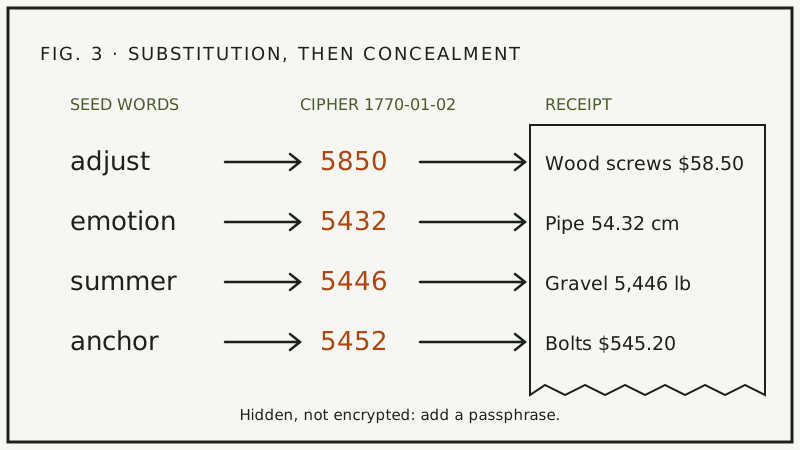
A substitution cipher replaces each letter or character in the plaintext with another letter or character according to a predetermined rule or mapping. Examples of substitution ciphers include the Caesar cipher, where each letter is shifted to a certain number of positions in the alphabet, and the Atbash cipher, where the alphabet is reversed (A becomes Z, B becomes Y, and so on).
Transposition ciphers
On the other hand, Transposition ciphers rearrange the order of the letters in plaintext without changing the actual letters themselves. The Rail Fence cipher and the Columnar Transposition cipher are examples of transposition ciphers.
Symmetric-key ciphers,
Symmetric-key ciphers, also known as secret-key ciphers, use the same key for encryption and decryption. The key is kept secret and known only to the sender and receiver. Examples of symmetric-key ciphers include the Advanced Encryption Standard (AES), today’s standard, and the older Data Encryption Standard (DES), which is no longer considered secure.
Asymmetric-key ciphers
Asymmetric-key ciphers, or public-key ciphers, use a pair of mathematically related keys: a public key for encryption and a private key for decryption. The public key can be freely shared with others, while the private key is kept secret. The RSA algorithm is a well-known example of an asymmetric-key cipher.
Modern ciphers often combine various techniques to provide stronger security and resist attacks. They are essential to secure communication, ensuring that sensitive information remains confidential and protected from unauthorized access.
Bitcoin terms on this site
The words below come up on every page about seeds. Each links to the standard that defines it.
BIP-39
The standard for seed phrases. It defines the list of 2,048 words, how 12 to 24 of them are picked from random data plus a checksum, and how the words and an optional passphrase become the wallet seed. Every cipher on this site maps the English BIP-39 list. More on BIP-39.
Checksum
The last few bits of a seed phrase, taken from a SHA-256 hash of the rest: 4 bits for 12 words, 8 bits for 24. Wallets use it to catch a mistyped word. It also lets anyone test whether a list of words could be a real seed, which is why a recognised list can be tried against all of our public ciphers in minutes (how).
Passphrase
Extra text you add to your seed words, sometimes called the 25th word. BIP-39 mixes it into the wallet seed, so every passphrase opens a different wallet and a wrong one opens an empty wallet without any error. It is the lock on a seed hidden with our ciphers. Keep it apart from your numbers. Choosing, storing and testing one.
BIP-32
The standard for hierarchical deterministic (HD) wallets: one seed grows a whole tree of keys, so one backup covers every address the wallet will ever use.
BIP-44
A standard map for that tree. The path m / purpose' / coin_type' / account' / change / address_index tells a wallet where to find each address. Bitcoin's coin type is 0. Knowing which path your wallet used helps another wallet find your coins during recovery.
xpub (extended public key)
A public key plus a chain code, written as a 111-character string starting xpub. It lets watch-only software see every address and balance in an account, but not spend. Treat it as private anyway: it shows your whole history, and BIP-32 warns that an xpub plus any one of its non-hardened child private keys gives away the parent private key.